


Depot Charging Infrastructure: A Strategic Priority for Europe’s EV Fleets
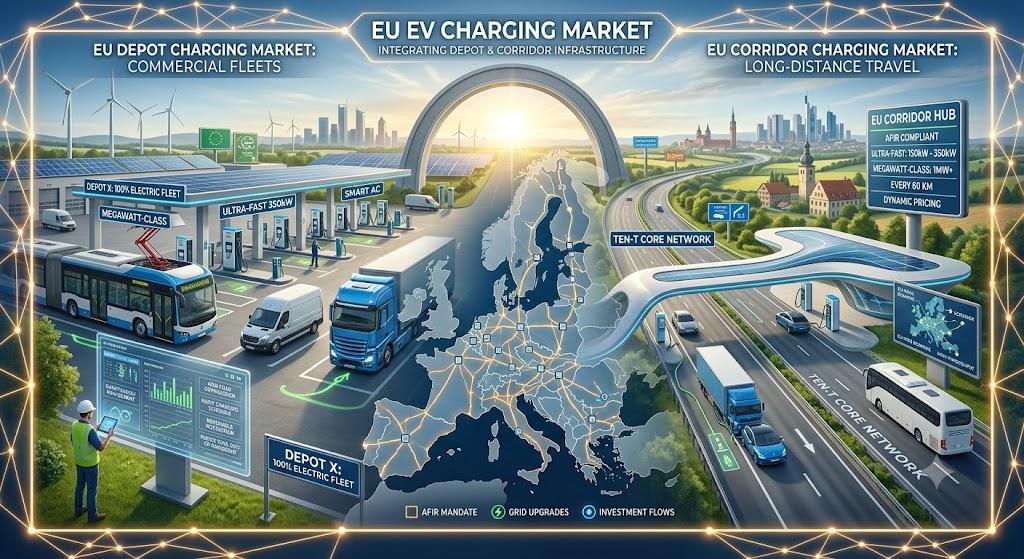
EU Depot & Corridor EV Charging Industry and the Future of Electric Mobility
Europe’s commercial transport system is gradually moving toward electrification, creating demand for infrastructure that can support vehicles throughout their operating cycles. Fleet depots provide controlled charging environments, while corridor networks enable vehicles to travel farther without returning to their home facilities. Together, these infrastructure models can form an interconnected foundation for electric commercial mobility.
The EU Depot & Corridor EV Charging Industry includes charger manufacturers, software providers, utilities, charging operators, vehicle companies, infrastructure developers, construction firms, and energy service providers. Their roles increasingly overlap as customers seek complete solutions rather than individual pieces of charging equipment.
Fleet depots are often the starting point for electrification because operators have greater control over vehicles and charging schedules. A delivery company, for example, can coordinate charging with vehicle return times and next-day departure requirements. This predictability allows software to optimize charging while helping operators manage available electrical capacity.
The infrastructure required at a depot depends on vehicle numbers, battery sizes, operating patterns, and charger power. Small fleets may need relatively simple installations, while larger operations can require substantial electrical upgrades. Transformers, distribution equipment, cabling, charging hardware, communications systems, and energy management platforms may all become part of the project.
Corridor charging serves a different purpose. Vehicles operating across regions need charging locations that fit naturally into established routes. For electric trucks, charging hubs may need high-power equipment, large parking spaces, appropriate vehicle access, and reliable availability. The quality of the surrounding network can influence whether fleet operators consider longer electric routes practical.
Grid availability remains a central issue. A suitable charging site may not have enough local electrical capacity to support planned demand. Developers therefore need to assess grid connection timelines and upgrade requirements during project planning. Early coordination with network operators can help identify technical constraints and potential solutions.
Energy management can help infrastructure operate more efficiently. Smart systems can prioritize charging according to fleet requirements, electricity prices, renewable generation, and grid conditions. This can be particularly valuable at large depots where uncontrolled charging could create substantial demand peaks.
Storage and onsite generation may provide additional flexibility. Solar installations can generate electricity during daylight hours, while batteries can shift energy availability toward periods when vehicles need charging. These technologies do not eliminate the need for grid connections, but they can become complementary components of a broader energy strategy.
Maintenance will also remain essential. Commercial fleets depend on vehicle availability, meaning charger downtime can directly affect operations. Predictive monitoring, remote diagnostics, spare-parts management, and responsive field services can help maintain high infrastructure availability.
The industry is also moving toward greater digital integration. Charging platforms can connect vehicles, chargers, energy systems, payment tools, and fleet-management applications. This connectivity can provide operators with a consolidated view of charging performance and energy consumption.
Future deployment will require scalable infrastructure. Fleet operators need systems that can accommodate additional electric vehicles without requiring complete site reconstruction. Modular chargers, expandable electrical systems, software upgrades, and adaptable parking layouts can support this objective.
As European commercial transportation electrifies, depot and corridor charging will increasingly function as connected infrastructure rather than separate projects. Their development involves transportation planning, energy management, digital technology, construction, and financial investment. Coordinated deployment can help create reliable charging coverage while supporting efficient fleet operations and the continued evolution of Europe’s electric mobility ecosystem.

 English
 Arabic
 French
 Spanish
 Portuguese
 Deutsch
 Dutch
Dutch
 Italiano
 Russian
 Romaian
 Portuguese (Brazil)
 Greek
Greek
 Indonesia