


Europe Offshore Wind Market Growth: What Industry Stakeholders Should Know
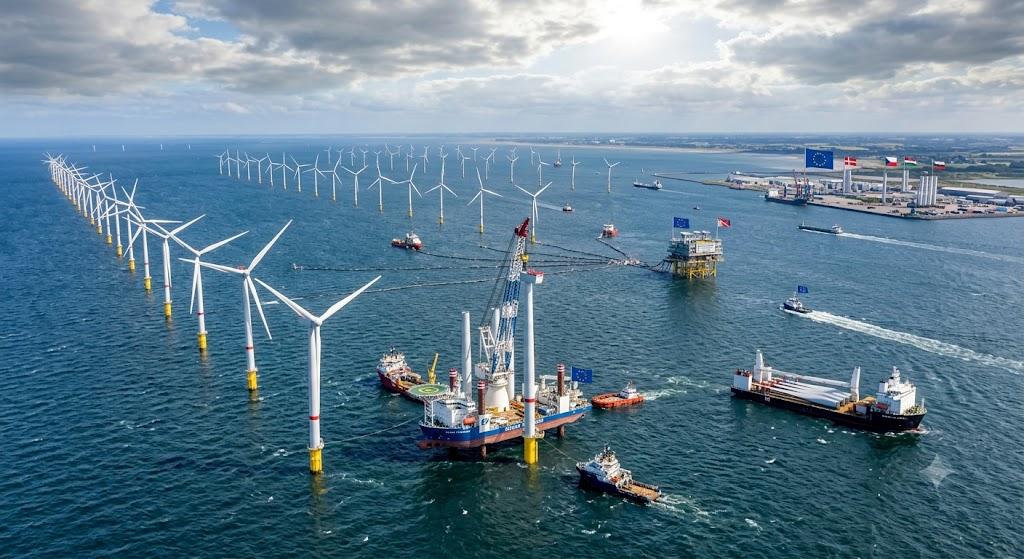
The Future of Offshore Wind Development Across Europe
Offshore wind is becoming an increasingly visible part of Europe's renewable energy strategy. The Europe Offshore Wind Market combines large-scale electricity generation with industrial development, infrastructure investment, and long-term decarbonization objectives. Its expansion is supported by extensive coastlines, strong offshore wind resources, and growing demand for low-carbon electricity, although development conditions differ considerably between countries.
The market's structure is shaped by several stages. Developers first identify suitable seabed areas and assess wind resources, environmental conditions, grid access, and technical feasibility. Leasing or tender processes then determine development rights. Projects must progress through environmental studies, permitting, financing, procurement, construction, and commissioning before generating electricity. Each stage can introduce delays, making coordinated project management essential.
Permitting has become a major focus because offshore projects interact with multiple marine activities. Fisheries, shipping, defense, tourism, conservation, and existing energy infrastructure may all compete for the same areas. Governments are increasingly using marine spatial planning to organize these interests. Clearer processes can reduce uncertainty, but developers still need detailed assessments and sustained engagement with affected stakeholders.
Grid connection is another defining factor. Offshore projects often produce electricity far from the locations where demand is concentrated. New export cables, substations, onshore reinforcements, and potentially cross-border interconnectors are required to move power efficiently. If generation capacity grows faster than transmission infrastructure, projects can face connection delays or operational constraints. Integrated planning can help align investment decisions on both sides.
Electricity market design also influences project bankability. Developers need confidence that future revenues will support large capital commitments. Contracts for difference, power purchase agreements, merchant exposure, or combinations of revenue mechanisms can provide different levels of stability. The preferred model varies by market and project risk profile. Clear rules can encourage investment while helping consumers manage long-term energy costs.
Technology continues to alter project design. Turbine sizes have increased significantly, allowing developers to produce more electricity from fewer units. Improvements in blades, generators, foundations, cables, and control systems can increase efficiency and reliability. Digital tools can support remote monitoring, predictive maintenance, and performance optimization. However, larger equipment also creates new logistical requirements for ports, vessels, transport routes, and installation operations.
Floating offshore wind could become an important growth avenue as development moves into deeper waters. Floating platforms can potentially access stronger wind resources and reduce geographic limitations associated with fixed foundations. The technology is still progressing toward broader commercial deployment, with cost reduction, manufacturing scale, installation methods, and supply chain readiness remaining important priorities.
Stakeholders assessing Europe Offshore Wind Market Size should consider both current installations and the broader project pipeline. Capacity under development can indicate future expansion, but pipeline figures must be interpreted carefully because projects may change scope, encounter permitting obstacles, or experience delays. Evaluating project maturity provides a more useful view of actual market potential.
Supply chain investment can strengthen the sector's long-term competitiveness. New manufacturing facilities and upgraded ports can create skilled employment while supporting regional economic activity. Specialist training is also necessary because offshore construction and maintenance require engineers, technicians, marine crews, and other highly qualified workers. Workforce development can become a strategic advantage as deployment accelerates.
Offshore wind can also support wider energy system integration. Renewable electricity may serve electrified industrial processes, charging infrastructure, heating, and hydrogen production. Combined with storage and interconnection, offshore generation can contribute to a more flexible power system. These applications may become increasingly relevant as European electricity consumption changes.
Ultimately, successful development will require practical regulation, investable projects, modern grids, capable supply chains, advanced technology, and responsible marine planning. When these elements align, offshore wind can support Europe's energy transition, industrial competitiveness, and electricity security with Europe.

 English
 Arabic
 French
 Spanish
 Portuguese
 Deutsch
 Turkish
 Dutch
Dutch
 Italiano
 Romaian
 Portuguese (Brazil)
 Greek
Greek
 Indonesia