Industrial facilities often need reliable ways to remove unwanted air and maintain a more suitable working environment, making an Industrial Air Exhaust Fan an important part of many ventilation systems. Zhejiang Shenli Explosion proof Electromechanical Co., Ltd. focuses on electromechanical and explosion-proof ventilation applications, providing a useful perspective on how materials, structural design, airflow technology, maintenance, and practical usability can influence exhaust fan selection.
Material selection is one of the first considerations when evaluating an exhaust fan. The fan may operate in environments containing moisture, dust, heat, chemical substances, or other airborne contaminants, so the materials used for the housing, blades, protective structures, and internal components should correspond with the intended application. Metal construction can provide structural stability, while suitable surface treatment can help address environmental exposure.
The fan housing has an important role because it protects internal components while guiding air toward the exhaust path. A well-designed housing should maintain structural rigidity and provide practical access for inspection where required. Its connection with the surrounding wall, duct, or ventilation opening should also be considered during product selection because installation conditions can influence the overall ventilation arrangement.
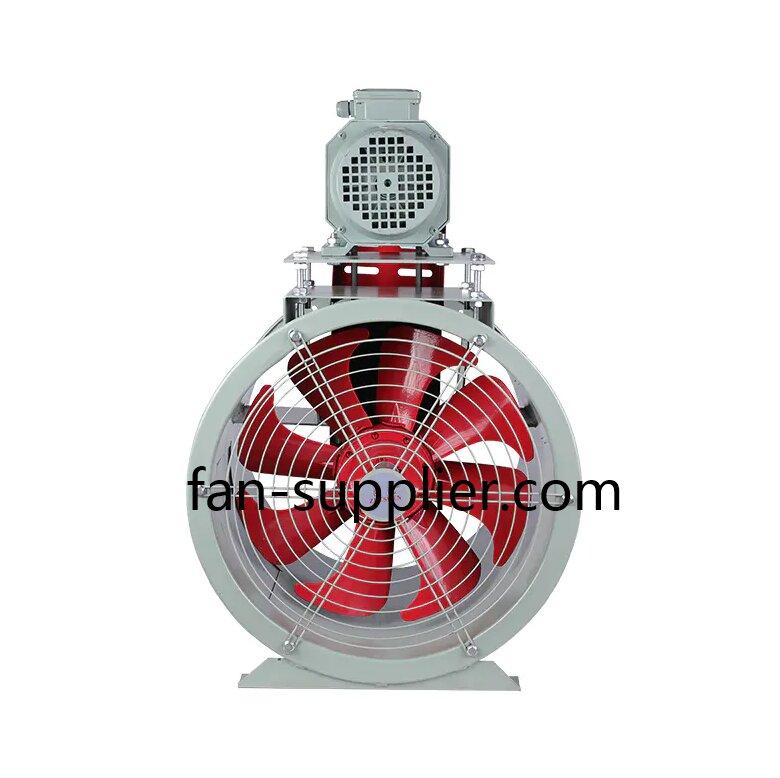
Blade construction is another major factor. The blades determine how mechanical rotation is translated into moving air, so their shape, material, balance, and surface condition can influence airflow behavior. A carefully designed blade should work efficiently with the housing and motor rather than being considered independently. Consistent manufacturing is particularly important because differences between blades can affect balance and operating smoothness.
When choosing an exhaust fan, buyers should first understand the air quality challenges within the intended environment. Workshops may need to remove heat and airborne particles, warehouses may require general air circulation, and specialized facilities may need controlled exhaust arrangements. Identifying the actual ventilation objective helps buyers compare equipment according to application rather than simply focusing on the physical appearance of the fan.
Installation conditions should also be evaluated. Exhaust fans can be integrated into walls, ducts, openings, or larger ventilation systems. The available mounting structure and direction of airflow need to correspond with the fan's design. Practical installation features can make positioning easier, while accessible components can simplify future inspection and maintenance.
Airflow technology depends on the coordinated operation of several components. The motor drives the fan assembly, the blades generate movement, and the housing guides the air. Bearings, electrical connections, protective guards, and mounting structures also influence the complete operating system. A well-engineered fan considers how these elements interact instead of treating each component as an isolated feature.
Special environments require additional attention to safety. Industrial areas may contain combustible gases, vapors, or dust, creating specific requirements for electrical and mechanical equipment. Explosion-proof ventilation products need careful coordination between the motor, electrical system, housing, and other components. Zhejiang Shenli Explosion proof Electromechanical Co., Ltd. specializes in explosion-proof electromechanical applications, making environment-specific safety considerations an important part of its product development approach.
Maintenance is another factor that should influence purchasing decisions. Exhaust fans can gradually collect dust and airborne particles, particularly when installed in workshops or processing areas. Blade surfaces, protective guards, housings, and other accessible sections may require regular inspection and cleaning. A design that allows technicians to reach relevant components conveniently can make routine maintenance more manageable.
User experience in industrial ventilation is largely connected with operation and serviceability. Technicians should be able to understand the equipment layout and access important components without unnecessary difficulty. Clear structural organization can support easier inspection, while practical mounting and service arrangements can help reduce interruptions to facility operations.
Noise and vibration can also influence the working environment. An exhaust fan with properly balanced rotating components and a stable mounting structure can support smoother operation. Unusual vibration or sound may indicate a mechanical issue, installation problem, or component condition that deserves inspection. Considering these factors can help buyers look beyond airflow alone when evaluating equipment.
Appearance can contribute to equipment integration, especially when ventilation units are visible within a workshop or commercial facility. Clean surfaces, orderly protective guards, consistent finishing, and a practical housing shape can give the equipment a professional appearance. Good industrial design should support function while avoiding unnecessary visual complexity.
For manufacturers and facility operators, selecting exhaust ventilation equipment involves more than choosing a fan that moves air. Material compatibility, housing and blade construction, installation conditions, airflow technology, safety, maintenance, operating experience, and visual design all deserve consideration. Zhejiang Shenli Explosion proof Electromechanical Co., Ltd. focuses on electromechanical and explosion-proof ventilation applications, with attention to practical industrial requirements and product engineering. Further information about its fan products and related solutions is available at https://www.fan-supplier.com.




 Arabic
 French
 Spanish
 Portuguese
 Deutsch
 Turkish
 Dutch
Dutch
 Italiano
 Russian
 Romaian
 Portuguese (Brazil)
 Greek
Greek
 Indonesia