


Europe’s Renewable Expansion Creates a Battery Storage Surge
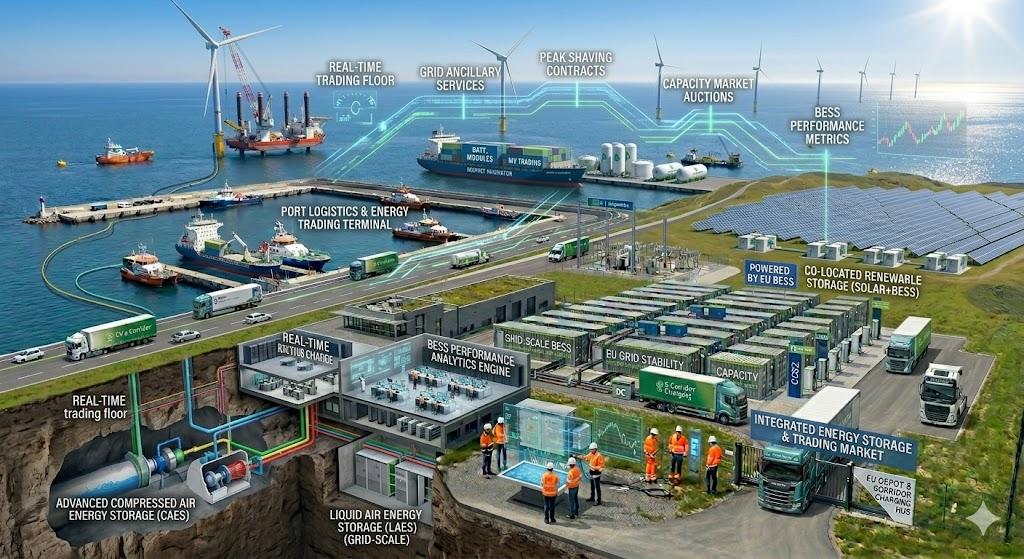
How Battery Storage Could Reshape Europe’s Electricity System
Europe’s electricity markets are changing rapidly, and battery storage is emerging as one of the key technologies supporting that transition. Renewable generation is expanding, electrification is increasing demand for flexible capacity, and network operators need tools that can respond quickly to changing system conditions. These developments are creating a broad opportunity for batteries across both independent and renewable-linked projects.
The Europe Battery Storage (Grid + Co-located) Market is particularly relevant because it brings together two important deployment models. Grid-scale batteries operate as flexible network assets, while co-located batteries work alongside solar or wind generation. Although their physical technologies may overlap, their operating strategies, revenue sources, and development priorities can differ.
Grid-scale systems can provide frequency response, balancing, reserve services, and energy trading. Their rapid response capability allows them to support the grid during short-term changes in supply or demand. In some markets, batteries can also participate in capacity mechanisms or other structured programs. The ability to combine several services can improve utilization and create a more resilient commercial model.
Co-located systems are closely linked to renewable generation patterns. Solar projects can produce large volumes of electricity during daytime hours, sometimes when market prices are relatively low. Wind output can also coincide with periods of abundant generation. Storage allows developers to shift some electricity to later periods, potentially improving project economics and reducing curtailment.
The choice between standalone and co-located development is not always straightforward. This evolution will reward developers that understand market signals, design assets around specific system needs, and maintain disciplined financial and technical assumptions throughout project development. Grid batteries may benefit from strategic network locations, but they can face connection queues, land constraints, and uncertain revenue conditions. Co-located projects may use existing renewable sites and infrastructure, yet they must manage technical coordination between generation and storage. Detailed feasibility studies are therefore essential before selecting a project structure.
Market design will strongly influence future deployment. Batteries need access to suitable revenue opportunities, transparent rules, and pricing mechanisms that recognize flexibility. If storage is exposed to unnecessary network charges or restricted from participating in certain markets, project economics can weaken. Clear treatment of batteries as flexible assets can help reduce uncertainty and encourage investment.
Technology decisions are equally important. Lithium-ion systems remain widely used because of their commercial maturity, energy density, and established supply chain. However, longer-duration applications may encourage interest in alternative chemistries and technologies. Developers will increasingly compare safety, degradation, cycle life, duration, efficiency, warranties, and lifecycle costs rather than focusing only on initial capital expenditure.
Digital controls are becoming a major source of project value. Energy management systems can forecast renewable output, monitor electricity prices, evaluate battery health, and optimize dispatch. Automated decision-making can help operators respond to market changes quickly. For larger portfolios, centralized control platforms can coordinate multiple projects and identify opportunities across several markets.
Investment decisions will also depend on operational risk. Battery projects require robust maintenance plans, thermal management, cybersecurity, and equipment monitoring. Warranty structures and replacement assumptions can influence long-term financial performance. Investors are therefore examining the complete lifecycle of an asset, from procurement and commissioning through operation, augmentation, and eventual recycling.
The Europe Battery Storage (Grid + Co-located) Market Share perspective can help stakeholders understand competitive positioning, project deployment, technology choices, and the factors shaping market participation.
Europe’s storage sector is moving toward an integrated energy-services model. The strongest projects will combine appropriate technology with strong locations, sophisticated controls, flexible revenue strategies, and reliable operations. As renewable penetration and electricity demand continue to evolve, batteries can become increasingly important in connecting generation, networks, and consumers within a more flexible power system.

 English
 Arabic
 French
 Spanish
 Portuguese
 Deutsch
 Dutch
Dutch
 Italiano
 Russian
 Romaian
 Portuguese (Brazil)
 Greek
Greek
 Indonesia