


3D Laser Cutting Machine Market: High-Precision Technology Shapes the Future of Manufacturing
3D Laser Cutting Machine Market Size
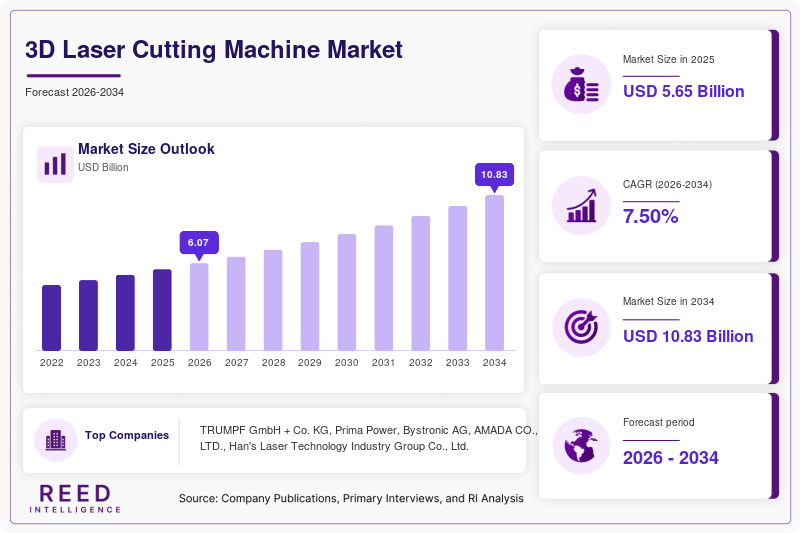
The global 3D laser cutting machine market size was valued at USD 5.65 billion in 2025 and is projected to grow from USD 6.07 billion in 2026 to USD 10.83 billion by 2034, registering a CAGR of 7.50% during the forecast period from 2026 to 2034.
The 3D laser cutting machine market is centered on multi-axis laser systems capable of cutting three-dimensional or formed components with high positional accuracy. Unlike conventional 2D systems, these machines can follow complex contours and process components after forming, enabling manufacturers to consolidate trimming, piercing, and contour-cutting operations. This capability is particularly relevant for automotive body structures, hot-formed components, aerospace parts, and industrial machinery.
Automotive manufacturing remains a major application because lightweight structures increasingly combine high-strength steels, aluminum alloys, and complex formed geometries. Prima Power specifically identifies high-strength steel processing and lightweight automotive body components as important applications for 3D laser technology.
Request a Sample: https://reedintelligence.com/market-analysis/3d-laser-cutting-machine-market/request-sample
3D Laser Cutting Machine Market Drivers
Expansion of Automotive Lightweight Manufacturing
Automotive manufacturing is a major demand center for 3D laser cutting because vehicle structures increasingly require high-strength steel, aluminum, and complex formed geometries. Prima Power describes 3D laser processing as particularly suitable for lightweight body parts manufactured from high-strength steels, while TRUMPF applies its 3D systems to components such as B-pillars, tailgates, and rear-seat structures.
Formed components often require trimming and piercing after pressing. Multi-axis laser systems can perform these operations without requiring dedicated tooling for every geometry. This reduces dependence on fixed cutting dies and provides manufacturers with greater flexibility when vehicle designs or component specifications change.
Growth of Smart Manufacturing and Automated Laser Cells
Automation is changing purchasing requirements for industrial laser equipment. A 2026 industry assessment reports that approximately 52% of factories surveyed were integrating robotic laser cutting arms, while AI-based optimization and IoT-enabled systems were also gaining adoption.
Manufacturers increasingly connect laser systems with production-management software, automated material handling, and process-monitoring platforms. TRUMPF supports OPC-UA integration for monitoring and analysis tools, while Prima Power positions its 3D laser platforms for automated production environments.
This changes the commercial proposition from machine productivity alone to throughput per production cell, process consistency, and reduced operator intervention.
Increasing Precision Requirements in Aerospace and Industrial Manufacturing
Aerospace and industrial equipment manufacturers require accurate processing of complex components while controlling material utilization and secondary machining. Fiber-laser 3D systems can process materials including high-strength steels, aluminum, and titanium while maintaining programmable multi-axis motion.
Prima Power identifies aerospace, defense, heavy trucks, industrial equipment, power generation, and rail among applications served by its 3D laser technology. The technology is particularly relevant for components with irregular surfaces or difficult-to-access cutting paths, where conventional planar systems may require additional fixtures or machining stages.
3D Laser Cutting Machine Market Restraints
High Capital Cost and Integration Requirements
3D laser cutting systems require sophisticated motion control, optics, safety systems, and software compared with conventional cutting equipment. The investment extends beyond the machine itself to laser sources, automation, fixtures, extraction systems, programming platforms, and operator training.
The cost issue is particularly relevant to small and medium-sized manufacturers with variable production volumes. The economic case depends on machine utilization, part complexity, labor costs, and the amount of secondary processing eliminated through multi-axis laser cutting.
Skilled-Operator and Process-Programming Requirements
Multi-axis laser cutting requires specialized programming, calibration, and process knowledge. Operators must manage laser parameters, tool paths, workholding, collision avoidance, and material-specific cutting conditions.
Industry research identifies shortages of skilled operators and difficulties integrating software with legacy production systems as adoption barriers. Manufacturers are therefore increasing investment in simplified programming, automated parameter selection, and machine-learning-assisted process control.
TRUMPF and Prima Power both emphasize simplified programming and integrated software capabilities within their current 3D laser systems.
3D Laser Cutting Machine Market Opportunities
EV Structural Components and Battery Manufacturing
Electric-vehicle manufacturing creates applications for 3D laser processing across chassis structures, formed body components, and other lightweight assemblies. Laser cutting can accommodate frequent design changes while reducing reliance on fixed tooling associated with certain conventional trimming processes.
The opportunity is strengthened by the need to balance lightweight construction with structural strength. 3D laser systems can process high-strength steels and aluminum alloys used in vehicle structures, while automated cells can connect cutting operations with downstream welding and assembly.
TRUMPF's hot-forming technology and Prima Power's automotive-focused Laser Next platforms demonstrate the alignment between 3D laser processing and evolving vehicle production requirements.
AI-Enabled and Fully Automated Production Cells
The integration of AI, robotics, machine vision, and digital production systems creates opportunities for higher machine utilization and reduced programming requirements.
Industry research identifies AI-based optimization, robotic cutting, and digital-twin deployment as emerging components of modern 3D laser production environments. Manufacturers are increasingly developing systems that reduce setup time, automate process adjustments, and connect machines with factory-level monitoring.
Prima Power's Giga Laser Next uses multiple synchronized laser heads and automated production-line integration, while TRUMPF continues to introduce AI-enabled laser-processing systems.
3D Laser Cutting Machine Market Segmental Analysis
By Type
Fiber Laser Cutting Machines represented the dominant technology category with approximately 51% market share. Their position reflects higher efficiency, strong suitability for metal processing, and increasing integration into automated manufacturing systems. The technology is particularly relevant to automotive, aerospace, and industrial applications involving steel and aluminum.
Solid-state Laser Cutting Machines represent the fastest-expanding technology category within the specialized precision segment, supported by applications requiring high accuracy in electronics, precision engineering, and specialized components.
CO2 Laser Cutting Machines account for approximately 33% share and retain relevance where manufacturers process non-metallic materials and operate established production systems, although fiber technology is increasingly replacing CO2 equipment in metal-processing applications.
By Application
Metal Materials Cutting accounted for approximately 68% of the market, making it the dominant application category. Automotive body structures, aerospace components, heavy machinery, and industrial equipment create substantial requirements for multi-axis metal cutting.
Steel, aluminum, and titanium processing are particularly relevant because formed components frequently require trimming or piercing after primary shaping.
Non-metal Materials Cutting represents approximately 32% of applications and covers polymers, composites, and other specialized materials. Adoption is supported by electronics, packaging, textiles, and lightweight-component manufacturing, although the overall 3D laser equipment base remains strongly oriented toward metal processing.
3D Laser Cutting Machine Market Regional Analysis
North America 3D Laser Cutting Machine Market
North America is the dominant region, accounting for approximately 28% share. The region benefits from established automotive, aerospace, defense, industrial machinery, precision engineering, and metal-fabrication industries, supporting demand for advanced 3D laser cutting systems.
Manufacturing modernization and increasing automation are strengthening adoption of multi-axis laser equipment for complex components.
The U.S. represents the primary regional demand center, with automotive, aerospace, defense, industrial equipment, and advanced manufacturing applications generating demand for high-precision cutting. Integration with robotics, automated material handling, digital production systems, and CNC platforms is increasing the use of 3D laser machines in flexible manufacturing environments.
Europe 3D Laser Cutting Machine Market
Europe is projected to register approximately 7.0% CAGR during 2026–2034. Germany, Italy, France, and the United Kingdom provide established automotive, aerospace, machine-tool, metalworking, and precision-engineering ecosystems.
These industries support demand for multi-axis laser processing of formed and complex components. Germany remains an important manufacturing center, while Italy contributes through machine tools and industrial equipment production.
Automotive and aerospace manufacturers are increasingly focused on automation, production flexibility, energy efficiency, and digitally connected manufacturing, supporting adoption of fiber-laser and automated 3D cutting systems.
Asia Pacific 3D Laser Cutting Machine Market
Asia Pacific is the fastest-growing region, with an estimated 8.6% CAGR during 2026–2034. The region combines large automotive manufacturing bases, electronics production, industrial machinery, metal fabrication, precision engineering, and expanding factory automation.
China, Japan, South Korea, and India represent major demand centers. China benefits from extensive automotive and machinery production, while Japan and South Korea have strong precision-manufacturing and advanced-technology ecosystems.
India is expanding industrial automation and automotive manufacturing capabilities. Increasing adoption of fiber lasers, robotics, smart factories, and automated production cells is strengthening regional demand.
Latin America 3D Laser Cutting Machine Market
Latin America is projected to register approximately 7.2% CAGR during 2026–2034. Regional demand is supported by automotive manufacturing, industrial machinery, metal fabrication, appliances, construction equipment, and broader manufacturing modernization.
Brazil and Mexico represent important industrial centers. Mexico's integration with North American automotive and industrial supply chains supports demand for precision cutting equipment, while Brazil provides applications across automotive, machinery, construction, and metalworking.
Equipment costs, financing, imported machinery, technical services, and operator availability remain important factors influencing regional adoption.
Middle East & Africa 3D Laser Cutting Machine Market
The Middle East & Africa region is projected to grow at approximately 7.4% CAGR during 2026–2034. Demand is associated with industrial diversification, infrastructure development, metal fabrication, energy equipment, construction, and investments in advanced manufacturing.
Manufacturing localization is gradually expanding the requirement for precision processing equipment.
The UAE and Saudi Arabia are developing manufacturing and industrial capabilities, while South Africa provides demand from engineering, mining-related equipment, metalworking, and industrial manufacturing.
Adoption is influenced by equipment investment costs, imported technology, technical support, operator training, and the development of automated manufacturing infrastructure.
3D Laser Cutting Machine Market Competitive Landscape
The competitive structure combines established European machine-tool manufacturers, laser technology suppliers, and Asian equipment manufacturers. Competition increasingly centers on machine dynamics, laser-source efficiency, automation, programming, machine footprint, and integration rather than simply nominal laser power.
TRUMPF maintains a broad portfolio spanning 3D cutting, welding, laser sources, software, and automation. Its TruLaser Cell systems can combine cutting and welding, while its current 3D platforms include automated programming, collision-management technologies, and OPC-UA connectivity.
Key Market Players
-
TRUMPF GmbH + Co. KG
-
Prima Power
-
Bystronic AG
-
AMADA CO., LTD.
-
Han's Laser Technology Industry Group Co., Ltd.
-
Yamazaki Mazak Corporation
-
Mitsubishi Electric Corporation
-
Coherent Corp.
-
IPG Photonics Corporation
-
Salvagnini Italia S.p.A.
-
LVD Company NV
-
Cincinnati Incorporated
-
Messer Cutting Systems
-
Jenoptik AG
-
Trotec Laser
3D Laser Cutting Machine Market Recent Developments
-
September 2026 – TRUMPF: TRUMPF showcased its latest manufacturing technologies at IMTS 2026, including the TruLaser Cell 3000, which combines 2D and 3D laser cutting, welding, and laser metal deposition in a compact processing platform.
-
April 2026 – Prima Power: Prima Power's Giga Laser Next was selected as a finalist for the 2026 Manufacturing Leadership Awards. The company reported that the four-head 3D laser system can provide more than 280% higher productivity per square foot and reduce average changeover time by up to 75% in its targeted high-volume production configuration.
3D Laser Cutting Machine Market Segments
By Type
-
Fiber Laser Cutting Machines
-
CO2 Laser Cutting Machines
-
Solid-state Laser Cutting Machines
By Application
-
Metal Materials Cutting
-
Non-metal Materials Cutting
By Region
-
North America
-
Europe
-
APAC
-
Middle East and Africa
-
LATAM
Frequently Asked Questions
What is the size of the 3D Laser Cutting Machine Market in 2026?
The global 3D Laser Cutting Machine Market is valued at USD 6.07 billion in 2026.
What will the 3D Laser Cutting Machine Market size be by 2034?
The global 3D Laser Cutting Machine Market is projected to reach USD 10.83 billion by 2034, registering a CAGR of 7.50% during the forecast period from 2026 to 2034.
What is the CAGR of the 3D Laser Cutting Machine Market?
The global 3D Laser Cutting Machine Market is projected to register a CAGR of 7.50% from 2026 to 2034.
Which type dominates the 3D Laser Cutting Machine Market?
Fiber Laser Cutting Machines are the dominant technology category, accounting for approximately 51% market share.
Which application dominates the 3D Laser Cutting Machine Market?
Metal Materials Cutting is the dominant application category, accounting for approximately 68% of the market.
Which region is expected to grow fastest in the 3D Laser Cutting Machine Market?
Asia Pacific is projected to be the fastest-growing region, with an estimated CAGR of 8.6% during 2026–2034.
Conclusion
The global 3D laser cutting machine market is projected to grow from USD 6.07 billion in 2026 to USD 10.83 billion by 2034, registering a CAGR of 7.50%. Expansion of automotive lightweight manufacturing, smart manufacturing, automation, and precision requirements across aerospace and industrial applications is supporting market growth.
Fiber Laser Cutting Machines remain the dominant technology category, while Metal Materials Cutting represents the largest application segment. Demand is also being supported by electric-vehicle manufacturing, automated laser cells, robotics, AI-enabled process optimization, and digitally connected production environments.
North America currently represents the largest regional market, while Asia Pacific is projected to record the fastest growth through 2034. The competitive environment is increasingly shaped by automation, laser-source efficiency, machine flexibility, software integration, and the ability to deliver high-productivity multi-axis processing.
Full Report: https://reedintelligence.com/market-analysis/3d-laser-cutting-machine-market

 English
 Arabic
 French
 Spanish
 Portuguese
 Deutsch
 Turkish
 Dutch
Dutch
 Italiano
 Russian
 Portuguese (Brazil)
 Greek
Greek
 Indonesia