


Small Modular Reactors in the EU: From Technology Development to Deployment
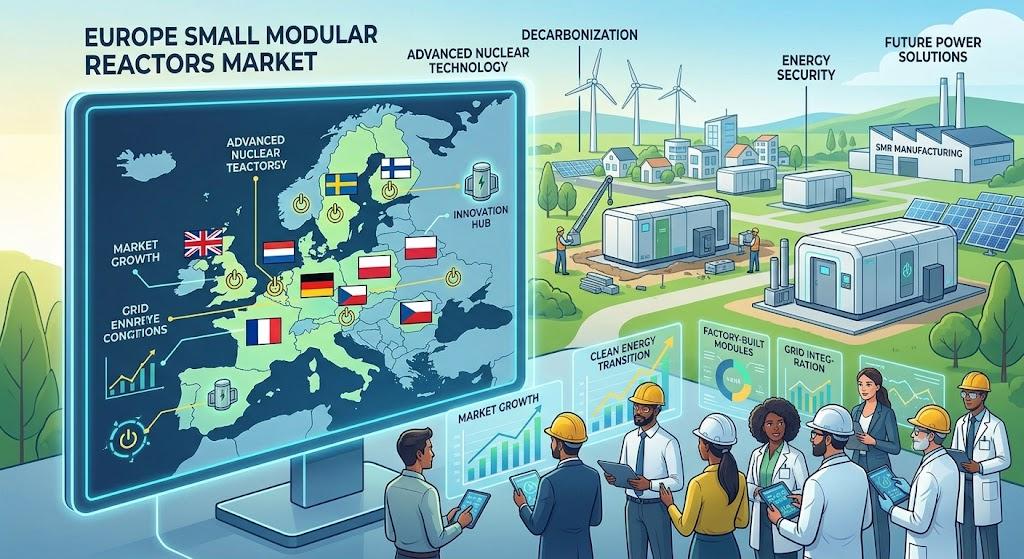
Understanding the Future Potential of European SMRs
Europe’s energy sector is exploring smaller reactor technologies as energy systems become more complex. The combination of renewable growth, industrial electrification, energy security priorities, and decarbonization targets is encouraging interest in dependable low-carbon generation. Small modular reactors may address some of these needs through smaller generating units and modular construction concepts, while also opening applications for industrial heat and integrated energy systems.
The EU Small Modular Reactors Market Size is influenced by more than installed capacity. The potential market includes reactor technology, engineering, construction, fuel, components, digital systems, maintenance, licensing support, financing, and associated infrastructure. Understanding the sector therefore requires a value-chain perspective that considers how investment may spread across multiple industries as projects progress from design to operation.
Utilities are an important potential customer group. Existing nuclear operators possess experience with licensing, plant management, safety culture, and nuclear procurement, which could support evaluation of new reactor concepts. However, utilities must still consider project economics, grid requirements, construction schedules, technology risk, and long-term waste responsibilities. Decisions will likely depend on the specific business model and national energy framework.
Industrial users may provide a different demand profile. Facilities that require continuous heat and electricity could potentially integrate an SMR with manufacturing operations, hydrogen systems, district heating, or other energy infrastructure. This could broaden the addressable opportunity beyond conventional power generation.
The economics of modular deployment are closely watched. A smaller reactor can reduce the absolute capital commitment for an individual unit, potentially allowing projects to be developed in stages. At the same time, smaller scale can affect the cost per unit of capacity. The commercial case therefore depends on whether standardization, factory production, shorter construction schedules, and repeat deployment can generate sufficient efficiencies.
Manufacturing is central to this equation. A large deployment program would require qualified suppliers capable of producing specialized nuclear components repeatedly and consistently. Production facilities must meet strict quality requirements, while workers need appropriate engineering, manufacturing, installation, and inspection skills.
Regulatory progress can materially influence project timing. Developers need clear requirements for design assessment, site approval, construction, commissioning, operation, environmental review, security, and decommissioning. Different national processes may complicate multi-country deployment. Greater coordination could reduce duplicated work, although national authorities will continue to retain responsibility for safety decisions under their respective legal frameworks.
The energy-market environment also matters. An SMR may generate value through electricity sales, capacity arrangements, industrial offtake, heat supply, or combinations of these channels. Developers may therefore seek long-term contracts or partnerships that align reactor investment with identifiable customer demand.
Technology selection presents another consideration. SMRs are not a single technical category. Designs can differ substantially in reactor type, fuel, output, operating temperature, safety architecture, construction method, and intended use. Buyers need to examine technology readiness and project evidence alongside theoretical performance.
Workforce development will become increasingly relevant if deployment expands. Europe needs engineers, operators, technicians, regulators, construction specialists, nuclear safety professionals, and skilled manufacturing workers. Europe’s existing nuclear workforce provides important experience, but new projects may require additional recruitment. A sustainable talent pipeline is therefore part of the broader commercialization challenge.
Public acceptance and local engagement also influence project development. Nuclear facilities require appropriate sites, transparent safety communication, environmental assessment, emergency planning, and long-term institutional arrangements.
The sector’s progress should be assessed through measurable milestones. Licensing submissions, site decisions, financing commitments, supply agreements, construction starts, and operating results provide increasingly concrete evidence of development. These indicators can help market participants distinguish strategic announcements from projects moving toward physical deployment.
As Europe evaluates multiple low-carbon pathways, SMRs may develop into a specialized component of future energy infrastructure rather than a universal solution. Their potential market depends on technology performance, policy support, financing, industrial demand, manufacturing capability, and regulatory execution. The EU Small Modular Reactors Market Size offers a useful framework for assessing these dimensions and understanding how the sector could evolve internationally.

 English
 Arabic
 Spanish
 Portuguese
 Deutsch
 Turkish
 Dutch
Dutch
 Italiano
 Russian
 Romaian
 Portuguese (Brazil)
 Greek
Greek
 Indonesia