


Why Choose Gangnammould Plastic Kitchenware Mould for Nylon Applications
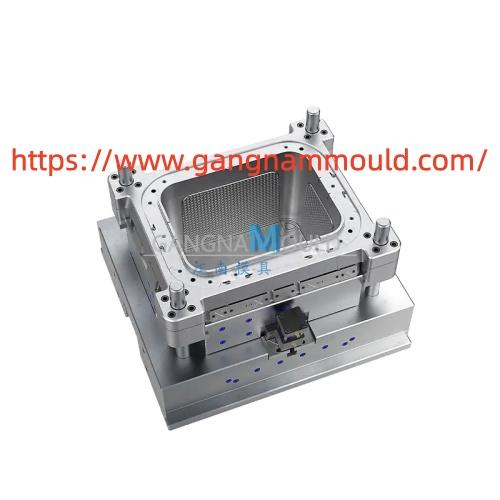
Plastic Kitchenware Mould selection starts with the material that will form the finished product. PP, PE, ABS, and nylon can all serve different applications, but their flow behavior, shrinkage, temperature requirements, surface expectations, and mechanical properties are not the same. Choosing the resin together with the tooling concept helps manufacturers create a more stable production process.
Polypropylene is widely used for containers, utensils, lids, storage products, and other household items. It offers low density, chemical resistance, and useful processing characteristics. Suitable food contact grades are also available for applications that require them. These characteristics make PP a practical option when manufacturers need lightweight parts with repeatable dimensions and reasonable production cycles.
However, PP also requires attention to shrinkage and cooling. Wall thickness should be designed with uniformity in mind, while gate positions and cooling channels need to support balanced filling and solidification. If these factors are overlooked, warpage or dimensional variation can become more difficult to control.
For bowls, storage containers, measuring tools, and similar products, the cavity surface is another important consideration. A properly polished surface can support easier release and help create a clean appearance on the finished item.
Polyethylene is another useful choice for household goods. Different PE grades can provide lightweight construction, impact resistance, and chemical resistance. This makes the material suitable for selected containers, storage products, and flexible components.
The grade still matters. HDPE and other polyethylene formulations can behave differently during processing, so the tooling design should be based on the actual resin specification rather than treating every PE material in the same way.
Cooling layout also deserves attention. A balanced cooling system can help reduce uneven contraction across larger surfaces. This is particularly relevant for containers and products with broad walls, where dimensional changes can affect lids, stacking, or assembly.
ABS is often selected when appearance and impact resistance are important. It can work well for household components that need a smooth finish and a firm structure. Compared with semi crystalline materials, ABS has different shrinkage behavior, which can make dimensional control more predictable for certain geometries.
For visually focused products, cavity polishing, texture control, gate positioning, and venting should be considered together. A good surface finish does not come from polishing alone. Material flow, cooling balance, and part design all influence the final result.
Nylon can be useful when a product requires greater mechanical strength, abrasion resistance, or temperature capability. At the same time, nylon absorbs moisture, so proper material preparation is important before processing. Mold temperature and cooling conditions also influence crystallization and final part properties.
For this reason, a tooling plan for nylon should consider drying requirements, processing temperatures, shrinkage, and dimensional targets from the beginning. A design that works well for PP may need different gating, cooling, or tolerance considerations when the resin changes.
Gangnammould works with customized tooling for everyday consumer products, including utensils, storage containers, dispensers, and other household items. Its product range includes solutions designed around different cavity layouts, surface requirements, cooling structures, and production needs.
Material selection is only one part of the decision. Cavity count, gate position, cooling channels, ejection method, surface texture, and maintenance access all affect production performance. For higher volume programs, multi cavity layouts may also be considered when the product geometry and production target justify them.
A practical approach is to define the finished products requirements before confirming the tooling structure. Manufacturers should consider operating temperature, food contact requirements where applicable, impact expectations, transparency, flexibility, wall thickness, appearance, and annual production volume.
The right combination can make production easier to manage while reducing unnecessary tooling changes later. Whether the selected resin is PP, PE, ABS, or nylon, the tooling should be developed around its actual processing behavior rather than relying on a standard structure.
Manufacturers evaluating customized solutions can review Gangnammould product options and related household tooling applications at https://www.gangnammould.com/product/ This provides a practical starting point for comparing available designs and discussing requirements for different materials and product structures.

 English
 Arabic
 French
 Spanish
 Portuguese
 Turkish
 Dutch
Dutch
 Italiano
 Russian
 Romaian
 Portuguese (Brazil)
 Greek
Greek
 Indonesia